Glad the feedback on the muffins was positive! Here's the recipe for all those interested. If I do varying amounts in the directions it's because I tweak it here and there. The amounts will be to make a dozen, so if you're making more just use your multiplication! And the tilde sign (~) means about by the way.
1 egg
1 cup mashed up bananas (about 2 decent sized bananas equal a cup, use your old frozen bananas for this!)
~1/3 cups of applesauce (I've used normal applesauce, and then cinnamon applesauce too to compliment the ground cinnamon)
2/3-3/4 cup of packed brown sugar
1 tsp vanilla
1 cup flour
1/2 tsp baking soda
2 tsp baking powder
1-1.5 tsp of salt
1 tsp ground cinnamon
1 cup of oats
box of raisins (just put as many as you want in)
chop up as many little carrot pieces as you want - i went pretty light on mine
can add nuts if you'd like - I used to use walnuts but they are expensive!
Get a large bowl and combine egg,
banana (stir bananas and egg together now in my opinion, the bananas are really chunky if you try to later with everything else in it), brown sugar, applesauce and vanilla. In a different bowl, throw the flour, baking soda, baking powder, salt and cinnamon together. Then combine the flour mixture and oatmeal into banana
mixture. After that you can stir in the raisins, carrots, nuts, etc. Then throw the batter in the muffin tins or the pan! I fill them just about halfway and that usually gives a good size and thorough baking.
Bake @ 350 F for roughly 16-20 minutes
Then, you know, just let 'em cool so you don't burn yourself! And wear oven mitts cause pans are really hot when they come out of the oven...

Monday, December 5, 2011

Share & Voice: Pinterest
 | |
| Wine Cork Upcycling |
 |
| Wine Cork Floormat |
 | |
| Pallet Upcycling |
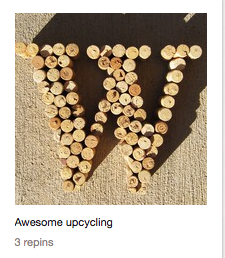
Although I briefly touched on the site last week in my Share & Voice post. I thought I would stress the usefulness and educate all of you a little more on Pinterest. Pinterest is a vision-board styled social website where you share ideas, interests, and your creativity with one another. You are allowed to 'like' pictures, similar to the style of Facebook, where you can then go back and reference the posts you have liked. The thing I am most enjoy is creating 'Boards'. You can 'Pin' pictures to your boards and create themes for yourself to follow. Personally, I have boards for things such as DIY projects, Photography Poses, and Rooms that I want in my future house! By simply searching in the search bar, you can find an incredible amount of ideas for recycling, upcycling, junking, and other DIY projects. You can also view people Boards, so when you are searching and find someone with a board titled 'Awesome Upcycling Ideas', chances are there are going to be lots more pictures within that board that aren't even listed in the search results! Let's say for example you have an excessive amount of wine corks laying around your house that you for some reason decided to keep (don't worry, I'm guilty too..). Simply searching 'Wine Cork Upcycling' will give you more results than you can even handle! If you are really into this, you could just look around at all the random things in you're home and start deciding what you could turn them into and soon you'll have a house full of hybrid products than were formerly useless! And you don't have to worry about forgetting what you saw or saving the link address to go back to later, just re-pin it to your Board that you have created! I hope that a lot of you are as interested in this site as me! It has already been a ton of help for me with my photography, and I have found lots of cool DIY ideas that I am looking forward to trying once I obtain the resources for them! You can also 'Follow' people on Pinterest, so if you find someone who has lots of common interests, follow them and you will see all of the posts they like or re-pin. I look forward to seeing lots of you on Pinterest so we can share ideas with each other!
Saturday, December 3, 2011
Advocacy Project : Fact Sheet
Motor Vehicle Pollution:
What You Have Already Done, and What You Can Do Now.
Facts on Fuels,
Rules, and Automobiles
Presented by Caleb
Taplin
How did this all get started?
-
It wasn’t until 1952 that automobiles were first acknowledged to be linked to
air pollution. Since then emissions have been increasing every year as more and
more people drive cars that lack fuel efficiency. In 1990, 54 million metric
tons of emissions were emitted from mobile sources.
What can be the side effects of these levels of emission?
-
Over 74 million people are exposed to high levels of at least one of the
pollutants found in emissions, which include carbon monoxide, volatile organic
compounds, oxides of nitrogen, sulfur dioxide, particulate matter, and lead.
All of these can have adverse health effects, and some other lower level
pollutants from vehicles are known carcinogens, such as benzene and
formaldehyde.
What can I do to help reduce my impact on these emissions?
-
When shopping for a vehicle, choose the most fuel-efficient
vehicle that meets your needs.
-
Look for vehicles that meet EPA low-emission or
ultra-low-emission standards.
-
Consider buying a flex-fuel vehicle, which can
operate on gasoline or E85 (Ethanol/Gasoline blend) and both combined.
-
Look into buying a hybrid, which offers 20 to 30
percent better mileage.
-
Perform regular maintenance. Failing to do so
could increase emissions.
What will the S.1285 Hybrid and Electric Trucks and Infrastructure Act
do to lower emissions?
-
Increase and extend through 2015 the tax credit
for new qualified hybrids.
-
Allow tax credit for fuel-efficient heavy trucks
and heavy electric vehicles.
-
Extend through 2014 the tax credit for
alternative fuel vehicle refueling property expenditures.
-
Allow a tax credit through 2014 for installation
of electric idling reduction devices.
As you can see, this bill has much to offer for the reduction of emissions, which is a necessity as we cannot continue to support the trend of growing emissions. Email, write, or call your Representatives and let them know how you feel on this issue.
Friday, November 25, 2011
Eye Opener: Photo Essay
 For my photo essay I thought it would be fun not only to take pictures of things being repurposed, but specifically things I found at Mom's house while I was back home for the holidays. I found it important to find out how much my Mom cared about converging and repurposing items, because I may not have realized it over the years but these thoughts have been impressed onto me now.
As I began looking around, it was not too hard to find things that had been repurposed. The first thing I found was simply an old crappy piece of wood that had been made into a beautiful mantle above our fireplace. After seeing that, nearby I found a plethora of beautiful quilts, which of course is just repurposing of old material sewn together. Either taking small worthless scraps that would otherwise go into a landfill somewhere or taking old shirts that are no longer wearable you can create masterpieces that also have very common purposes for warmth!
 The third repurposing I found was a gourd that had been turned into a birdhouse. So not only are you not creating waste, but you are creating a home for another living creature on our planet!
 The fourth item my mother pointed out to me was a beautiful painted clay piece that she turned over to show that it had been an old tile that had been pulled up from somewhere and rather than breaking or throwing it, someone had decided to turn it into art. The fifth item used to be a Japanese net anchor, which made it over to America and into our hands somehow, so it has since been repurposed into a decoration which when the light hits it just right!
 The sixth item I found was this old ice chest, which clearly has some age to it, but has since been touched up and repurposed to be an outside cabinet for general storage. Rather than going out and buying some fancy new cabinet system and throwing such a beautiful item away you can restore an old piece that is even better quality than what you would buy nowadays. The seventh item is now an outdoor lamp that fits the decor of the house very well, however it used to be the chimney cap of some sort on an old house. I thought this was a fascinating use and it looks like some similar items that go for hundreds of dollars at upper end design stores. You can make the same thing by yourself if you know where to look!
 The final item may be the simplest, yet one of the smartest repurposing items. The simple swing. As you can see in my picture, an old board was the choice for ours. You may also be familiar with the gold old fashioned tire swing. These ideas not only create fun things for young kids to keep occupied with, but instead of buying new swings that are made of plastic, or boards that have been treated with dangerous products, you can take an old board that serves little purpose or an old tire from the junkyard and create one yourself!
 These are just a few of the brilliant things that I found around my home. If you are interested in seeing what you can do with products laying around your house, go check out my post about a site where you can search for lots of exciting repurposing and up-cycling ideas.
Sunday, November 20, 2011
Advocacy Project: Issue Overview
The problem I am investigating is air pollution caused by the emissions from motor vehicles. In 1990, 54 million metric tons from mobile sources; that's 43% of total emissions! 1952 was the first time automobiles were acknowledged to be linked to air pollution (1). Past legislation dealing with regulation of air pollution includes the Clean Air Act of 1963, 1970, and 1990, all of which put tighter regulation on emission standards for motor vehicles. The bill I am investigating is the S.1285 Hybrid and Electric Trucks and Infrastructure Act, which aims to increase and extend the tax credit available to those who are buying hybrid, electric, or fuel-efficient trucks and other vehicles.
This issue affects anyone who lives in the vicinity of an area of traffic flow. Over 74 million people are exposed to high levels of at least one of the pollutants found in emissions, which include carbon monoxide, volatile organic compounds, oxides of nitrogen, sulfur dioxide, particulate matter, and lead (1). All of these can have adverse health effects, and some other lower level pollutants from vehicles are known carcinogens such as benzene and formaldehyde.
In this case, the losers are everyone who is exposed to these toxins and runs the risk of having adverse health effects from the exposure. The winners would be the companies that continue to manufacture vehicles irresponsibly and don't have to put any research and development money into creating more efficient cars to reduce emissions. A domino effect would also create another group of losers, petroleum companies, who would see a decline in sales as automobiles become more efficient. These companies have lots of lobbying dollars that they put to good use, delaying or defeating any bill that would cost them sales.
 The economic costs of this issue lie with the government and automobile manufacturers. The government spends money funding agencies devoted to testing products and air quality every year. The EPA's National Vehicle and Fuel Emissions Laboratory in Ann Arbor, MI tests over 1,000 vehicles every year to certify them. With 500 employees and utility costs over $1,000,000 every year, this comes at a pretty steep price (1). Automobile manufacturers are also bearing some of the economic responsibility, as previously mentioned, now that there are heavier government mandates for emissions they must spend money improving their vehicles. Some companies just meet the bare minimum, while others invest more in creating more efficient vehicles and can use this as a marketing pitch for the concerned consumer. Additional economic strain could be felt by those families that are unfortunate enough to develop an illness because of the poor air quality, forcing them to seek expensive medical attention. If these people are uninsured, with our current health care system we may all feel the impact of this financially if the government is forced to raise taxes to support a failing health care system, among other things.
Socially, the main issue that arises is the impact of having someone you know become ill from the air quality. Having a close friend or relative be struck with an illness can be devastatingly stressful and time consuming. We should not even have to consider this an issue, as it should be a given that we need to have the cleanest air possible and not have to think twice about breathing it in for fear we may become ill. We would all benefit from tighter legislation and more fuel-efficient vehicles on the road. It is our responsibility to each other to buy the best vehicle emission-wise so we do not harm each other, or the environment.
The barriers to solving this issue include economic, social, and political hurdles. Economically, it is very expensive to fund and research new technological advances to take the next step in reducing emissions. It is very expensive to fund this research, and often vehicle manufacturers are not willing to foot the bill, and most certainly petroleum companies couldn't care less. The government, as previously pointed out, must spend millions a year on testing these vehicles to make sure they are meeting the requirements. This would not be necessary if we could trust manufactures to do their job and be responsible. Socially, the boundaries are that even though there is an increase in efficient vehicles and new technology, more and more people every year are driving cars. With the population growing, it only makes sense that there would be more cars on the road (3). With people job hunting and taking jobs farther away from where they live in order to make ends meet in a recession, you can see that traveling farther distances has an effect on emissions too. One smart way that I found through my research that cities are reducing pollution is the installation of roundabouts, which reduce the need to come to complete stops and then accelerate, creating better fuel efficiency (3). Politically, barriers must be overcome ignoring political differences to make new standards. It has been over 20 years since a new Clean Air Act, and since then there have been many changes to the market infrastructure.
The main resource needed for this issue is money. Everything boils down to affordability. Companies have to be able to afford to research better technology, while we have to be able to afford the vehicles they are putting onto the production line. There is a delicate balance of interaction between all components, and currently things are not in balance.
Historically, a lot has been done to bring down the levels of air pollution for motor vehicles successfully. From implementing new technologies into vehicles to make them more fuel efficient, to creating more vehicle friendly roadways to reduce the need to stop or accelerate. Politically, the Environmental Protection Agency and the California Air Resources Board are the top dogs in creating legislation and regulation for the issue, and have created lots of programs for the prevention of emissions polluting the atmosphere at any higher levels.
Nearly every group of people, businessmen, and politicians would support not only this bill, but the cause as a whole. People want to live in a safer and cleaner environment. Businessmen such as those who run the automobile companies, although they would have to spend more developing technology, would be able to offer a superior product and potentially see an increase in sales based on their vehicles being more responsible. Politicians should want what their supporters want, so that being said they should support these causes as well. The only group that would not support this bill would be petroleum companies. The bill would put more fuel-efficient vehicles onto the roads, getting rid of old gas guzzling vehicles that these companies have relied upon for some long to boost sales because of poor fuel-efficiency.
The policy needs to be voted in law so we can continue having options and incentives as consumers. Without such tax credits being offered, people may simply go for a cheaper car that doesn't have as good of fuel-efficiency. Some may not even know this is an issue until they are informed they can get these hybrid or electric vehicles for less, only then being told how irresponsible their old vehicle was compared to the new alternatives. Voting yes on this policy will assist the country financially and environmentally.
Sources:
(1) EPA Powerpoint. <http://webcache.googleusercontent.com/search?q=cache:zA5E9LvcUckJ:www.epa.gov/oms/consumer/fapmve2.ppt+current+legislation+on+air+pollution+from+motor+vehicle+emissions&hl=en&gl=us>
(2) Maine Department of Health <http://www.maine.gov/dep/air/lev4me/effects.htm>
(3) Sovacool, B.K. and Hirsh, R.F. (2009). Beyond batteries: An examination of the benefits and barriers to plug-in hybrid electric vehicles (PHEVs) and a vehicle-to-grid (V2G) transition. Energy Policy. 37:1095-1103.

This issue affects anyone who lives in the vicinity of an area of traffic flow. Over 74 million people are exposed to high levels of at least one of the pollutants found in emissions, which include carbon monoxide, volatile organic compounds, oxides of nitrogen, sulfur dioxide, particulate matter, and lead (1). All of these can have adverse health effects, and some other lower level pollutants from vehicles are known carcinogens such as benzene and formaldehyde.
In this case, the losers are everyone who is exposed to these toxins and runs the risk of having adverse health effects from the exposure. The winners would be the companies that continue to manufacture vehicles irresponsibly and don't have to put any research and development money into creating more efficient cars to reduce emissions. A domino effect would also create another group of losers, petroleum companies, who would see a decline in sales as automobiles become more efficient. These companies have lots of lobbying dollars that they put to good use, delaying or defeating any bill that would cost them sales.
 The economic costs of this issue lie with the government and automobile manufacturers. The government spends money funding agencies devoted to testing products and air quality every year. The EPA's National Vehicle and Fuel Emissions Laboratory in Ann Arbor, MI tests over 1,000 vehicles every year to certify them. With 500 employees and utility costs over $1,000,000 every year, this comes at a pretty steep price (1). Automobile manufacturers are also bearing some of the economic responsibility, as previously mentioned, now that there are heavier government mandates for emissions they must spend money improving their vehicles. Some companies just meet the bare minimum, while others invest more in creating more efficient vehicles and can use this as a marketing pitch for the concerned consumer. Additional economic strain could be felt by those families that are unfortunate enough to develop an illness because of the poor air quality, forcing them to seek expensive medical attention. If these people are uninsured, with our current health care system we may all feel the impact of this financially if the government is forced to raise taxes to support a failing health care system, among other things.
Socially, the main issue that arises is the impact of having someone you know become ill from the air quality. Having a close friend or relative be struck with an illness can be devastatingly stressful and time consuming. We should not even have to consider this an issue, as it should be a given that we need to have the cleanest air possible and not have to think twice about breathing it in for fear we may become ill. We would all benefit from tighter legislation and more fuel-efficient vehicles on the road. It is our responsibility to each other to buy the best vehicle emission-wise so we do not harm each other, or the environment.
The barriers to solving this issue include economic, social, and political hurdles. Economically, it is very expensive to fund and research new technological advances to take the next step in reducing emissions. It is very expensive to fund this research, and often vehicle manufacturers are not willing to foot the bill, and most certainly petroleum companies couldn't care less. The government, as previously pointed out, must spend millions a year on testing these vehicles to make sure they are meeting the requirements. This would not be necessary if we could trust manufactures to do their job and be responsible. Socially, the boundaries are that even though there is an increase in efficient vehicles and new technology, more and more people every year are driving cars. With the population growing, it only makes sense that there would be more cars on the road (3). With people job hunting and taking jobs farther away from where they live in order to make ends meet in a recession, you can see that traveling farther distances has an effect on emissions too. One smart way that I found through my research that cities are reducing pollution is the installation of roundabouts, which reduce the need to come to complete stops and then accelerate, creating better fuel efficiency (3). Politically, barriers must be overcome ignoring political differences to make new standards. It has been over 20 years since a new Clean Air Act, and since then there have been many changes to the market infrastructure.
The main resource needed for this issue is money. Everything boils down to affordability. Companies have to be able to afford to research better technology, while we have to be able to afford the vehicles they are putting onto the production line. There is a delicate balance of interaction between all components, and currently things are not in balance.
Historically, a lot has been done to bring down the levels of air pollution for motor vehicles successfully. From implementing new technologies into vehicles to make them more fuel efficient, to creating more vehicle friendly roadways to reduce the need to stop or accelerate. Politically, the Environmental Protection Agency and the California Air Resources Board are the top dogs in creating legislation and regulation for the issue, and have created lots of programs for the prevention of emissions polluting the atmosphere at any higher levels.
Nearly every group of people, businessmen, and politicians would support not only this bill, but the cause as a whole. People want to live in a safer and cleaner environment. Businessmen such as those who run the automobile companies, although they would have to spend more developing technology, would be able to offer a superior product and potentially see an increase in sales based on their vehicles being more responsible. Politicians should want what their supporters want, so that being said they should support these causes as well. The only group that would not support this bill would be petroleum companies. The bill would put more fuel-efficient vehicles onto the roads, getting rid of old gas guzzling vehicles that these companies have relied upon for some long to boost sales because of poor fuel-efficiency.
The policy needs to be voted in law so we can continue having options and incentives as consumers. Without such tax credits being offered, people may simply go for a cheaper car that doesn't have as good of fuel-efficiency. Some may not even know this is an issue until they are informed they can get these hybrid or electric vehicles for less, only then being told how irresponsible their old vehicle was compared to the new alternatives. Voting yes on this policy will assist the country financially and environmentally.
Sources:
(1) EPA Powerpoint. <http://webcache.googleusercontent.com/search?q=cache:zA5E9LvcUckJ:www.epa.gov/oms/consumer/fapmve2.ppt+current+legislation+on+air+pollution+from+motor+vehicle+emissions&hl=en&gl=us>
(2) Maine Department of Health <http://www.maine.gov/dep/air/lev4me/effects.htm>
(3) Sovacool, B.K. and Hirsh, R.F. (2009). Beyond batteries: An examination of the benefits and barriers to plug-in hybrid electric vehicles (PHEVs) and a vehicle-to-grid (V2G) transition. Energy Policy. 37:1095-1103.

Monday, November 14, 2011
Share & Voice: Cell Phone Charging Station

Sunday, November 13, 2011
Advocacy Project: Healthy People/THOMAS
The HealthyPeople 2020 environmental objective I am interested in is improving outdoor air quality by means of reducing mobile emissions. Reducing emissions will decrease the risk of adverse health effects caused by airborne toxins. 1.8 million tons of mobile sources of air toxic emissions were reported in 2005, and the target would be 1.0 million tons of emissions.
S.1285 Hybrid and Electric Trucks and Infrastructure Act
Summary: Hybrid and Electric Trucks and Infrastructure Act - Amends the Internal Revenue Code to: (1) increase and extend through 2015 the tax credit for new qualified hybrid motor vehicles; (2) allow such credit for certain fuel-efficient heavy trucks and heavy electric vehicles; (3) extend through 2014 the tax credit for alternative fuel vehicle refueling property expenditures; (4) expand the definition of refueling property for electric motor vehicles to include panel upgrades, wiring, conduit, trenching, pedestals, and related equipment; and (5) allow a new tax credit, through 2014, for 50% of the cost, up to $3,500, for electric idling reduction devices installed on heavy-duty diesel powered on-highway vehicles.
Sponsor: Sen Kohl, Herb (WI) (introduced 6/28/2011) Cosponsors: Sen Blunt, Roy (MO) - 6/28/2011, Sen Hagan, Kay (NC) - 10/5/2011, Sen McCaskill, Claire (MO) - 9/19/2011
All actions: 6/28/11: Read twice and referred to the Committee on Finance.
Recommendation: Vote Yes for S.1285 Hybrid and Electric Trucks and Infrastructure Act
My Political Representative: Senator Herb Kohl (D, WI)
S.1285 Hybrid and Electric Trucks and Infrastructure Act
Summary: Hybrid and Electric Trucks and Infrastructure Act - Amends the Internal Revenue Code to: (1) increase and extend through 2015 the tax credit for new qualified hybrid motor vehicles; (2) allow such credit for certain fuel-efficient heavy trucks and heavy electric vehicles; (3) extend through 2014 the tax credit for alternative fuel vehicle refueling property expenditures; (4) expand the definition of refueling property for electric motor vehicles to include panel upgrades, wiring, conduit, trenching, pedestals, and related equipment; and (5) allow a new tax credit, through 2014, for 50% of the cost, up to $3,500, for electric idling reduction devices installed on heavy-duty diesel powered on-highway vehicles.
Sponsor: Sen Kohl, Herb (WI) (introduced 6/28/2011) Cosponsors: Sen Blunt, Roy (MO) - 6/28/2011, Sen Hagan, Kay (NC) - 10/5/2011, Sen McCaskill, Claire (MO) - 9/19/2011
All actions: 6/28/11: Read twice and referred to the Committee on Finance.
Recommendation: Vote Yes for S.1285 Hybrid and Electric Trucks and Infrastructure Act
My Political Representative: Senator Herb Kohl (D, WI)
Subscribe to:
Posts (Atom)